
网易云音乐
Takaichi avoids clear commitment to non-nuclear principles again at Nagasaki memorial_我的网站

一 |
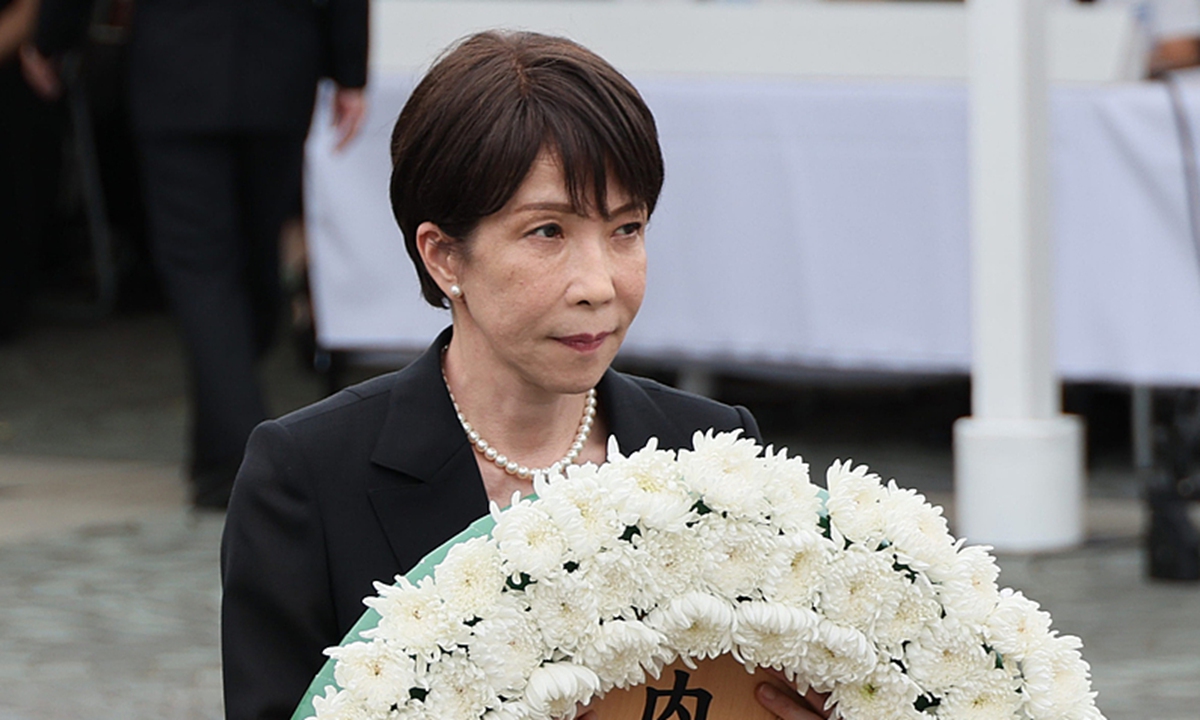
Chinese experts noted that, similar to her ambiguous remarks at the memorial ceremony in Hiroshima, Takaichi stopped short of making a clear commitment to maintaining the Three Non-Nuclear Principles in the future, as her government's stance on nuclear issues has sparked concern and anger among the Japanese public. They also warned that, given Japan's lack of thorough reflection on its wartime aggression, Tokyo's moves to dilute the Three Non-Nuclear Principles should raise alarm across the international community.
"Our country firmly upholds the three non-nuclear principles, and under the pledge that 'Nagasaki shall be the last city to suffer a nuclear attack,' we are promoting realistic and practical initiatives toward the realization of a world without nuclear weapons," Takaichi claimed, according to the Japan Times.
But unlike previous prime ministers, many of whom had pledged that Japan would "continue to uphold" the principles, Takaichi merely described the government's current position without making an explicit commitment about the future, per the report.
As Hiroshima observed the 81st anniversary of the US atomic bombing of the city on Thursday, Takaichi also emphasized that Japan pledges to achieve a world free of nuclear weapons while upholding the Three Non-Nuclear Principles, despite Japanese media noting that she has left the door open for future revisions.
Takaichi's remarks in Hiroshima and Nagasaki that Japan upholds the three non-nuclear principles were largely seen as a reaffirmation of the country's existing policy position rather than a pledge to maintain the principles in the future, Liu Jiangyong, a professor at the Institute of International Studies at Tsinghua University, told the Global Times.
Liu said that currently, some Japanese officials' dangerous remarks on nuclear have sparked criticism among Japanese society. He pointed out that Takaichi only referred to Japan's current adherence to the principles, without explicitly committing to preserving them going forward. Her subsequent focus on broader goals such as achieving a "world without nuclear weapons" has further fueled questions over her actual policy intentions.
Japanese Defense Minister Shinjiro Koizumi claimed in an online program released in July that discussions on nuclear weapons were necessary to strengthen Japan's defense capabilities, according to Kyodo News. While acknowledging that the issue was difficult to discuss in Japan, he claimed it was something that "could not be avoided."
Opposition to the Takaichi administration's nuclear-related moves has emerged across Japan, including from local governments, media organizations and civil society groups.
According to statistics from the Japanese Diet, at least 128 local assemblies across the country had submitted written opinions to the central government or parliament between Takaichi's inauguration on October 21 last year and July 28 this year, calling for the country's Three Non-Nuclear Principles to be upheld, according to Xinhua News Agency.
In an interview with the AFP, 82-year-old Satoshi Tanaka, a campaigner who survived the 1945 attack on Hiroshima expressed frustration that current political leaders like Takaichi are focusing on military capacity at the expense of diplomacy.
"There is so much talk about national security. What about building peace through diplomacy?" he said.
Responding to a question concerning the Japanese authorities are rebuilding Japan's war machine, seeking to revise the Three Non-Nuclear Principles, and pursuing nuclear sharing with the US, even the possession of nuclear weapons, Chinese Foreign Ministry spokesperson Lin Jian said on Thursday that the devastation and tragedies brought by nuclear weapons should never repeat themselves. That said, the particular context of the nuclear explosions should all the more be remembered and the lessons of Japanese militarism's aggression and expansion must forever serve as an alarm.
The Tokyo's moves on nuclear policy have also raised concerns in the international community.
Russia considers the rhetoric of Japanese authorities regarding the need for Japan to revise its Three Non-Nuclear Principles provocative and unacceptable, Russian Ambassador to Japan Nikolai Nozdrev said in an interview with RIA Novosti, which was published on Saturday.
Responding to Koizumi's remarks on nuclear discussion, Nozdrev said "This is the first time in Japan's history, as the only country to have suffered atomic bombings in Hiroshima and Nagasaki, that a sitting defense minister has publicly called for lifting the 'taboo' on discussions related to nuclear weapons. We consider such rhetoric from official Tokyo provocative and absolutely unacceptable."
Japan has yet to fully reckon with its wartime aggression, thus any attempt by Tokyo to move toward acquiring nuclear weapons could pose serious risks to regional peace and global security, Lü Chao, an expert on the Korean Peninsula issue at the Liaoning Academy of Social Sciences, told the Global Times.
Such concerns have become more pronounced as Japan increasingly portrays China as a major security challenge while highlighting perceived threats from other countries, against such a backdrop, any further steps to dilute the three non-nuclear principles are likely to heighten concerns internationally, particularly among countries that suffered from Japanese aggression during World War II, said Lü.
。 Harvard-affiliated scientists say they have been able to keep a monkey alive for two years with a genetically engineered pig kidney. Although preliminary, transplant experts say this research is an important milestone in the search for an alternative source of organs.Scientists are hopeful that one day, genetically modified organs grown in pigs may be able to significantly extend the life of people with end-stage organ failure.In recent months, other high-profile research teams at New York University and the University of Alabama at Birmingham announced successful transplants of genetically modified pig-kidneys into brain dead human donors. But those experiments ended after a few weeks."Duration of survival has been an Achilles heel of genetically modified pig organs to date due to a combination of rejection and opportunistic infections," said Dr. Peter Chin-Hong, director of the transplant infectious disease program at University of California, San Francisco.This new research, published in Nature, represents the longest period of time that scientists have been able to keep a non-human primate research animal alive."This proof-of-concept study provides real hope that transplantation of porcine [pig] donor kidneys into humans is very much on the horizon," Chin-Hong said.Still, experts cautioned that this new research was preliminary, and the idea of pig-grown organs is likely several years away from becoming a reality."If ultimately proved successful in human organ recipients - which is still years away at this point - this could be one of the key advances needed to make xenotransplantation a reality in clinical practice," said Dr. Josh Levitsky, president of the American Society of Transplantation.The new research was led by eGenesis, a company co-founded by Harvard geneticist George Church. In a press release, scientists at eGenesis said the new research will help lay the groundwork for formal clinical trials.In prepared remarks, eGenesis CEO Michael Curtis, PhD, said the company is focused on "improving long-term survival for transplant recipients from months to years."Eventually, the hope is that transplant doctors will be able to use genetically modified pig organs instead of solely relying on deceased human organ donors."Among all solid organs transplanted, kidneys are most sought after, expected to increase in demand further, and there is a significant shortfall of organs leading to premature deaths," Chin-Hong said.Every day, 17 people die waiting on the organ transplant list, according to the Health Resources & Services Administration. There are currently more than 100,000 people waiting on the national transplant list and a new person is added to the list every 10 minutes.。
Current article:http://8fug4.dinggaxilianmaiyuejienianguai.shop/news/20260826_94640.html
Published on:02:42:08
 售后不处理
售后不处理 前B站副总裁打造“非共识”AI陪伴,国内拿下千万用户后加速出海
 Xi calls for stronger China-Ecuador synergy in development strategies
 谷歌为 Pixel 11 系列手机测试 Gemini 驱动的“设备帮助”工具,可对话式排查手机故障
 SK 集团会长警示内存高价风险:芯片通胀或将冲击消费电子
 湖城潮启,乐遇公益——鄱阳白天鹅商圈新晋潮流体彩打卡地
我的网站最新内容
- ·詹姆斯+恩比德+布朗还只排第4!76人真正怕的不是东部
- ·巨人が発掘した“お宝”「めちゃ打ちにくそう」 止まらぬ快投…26歳を「獲れたのデカすぎ」
- ·Alef首次推出Model A飞行汽车 并希望从2025年开始销售
- ·“数”“智”赋能 加速装备制造业升级蝶变
- ·Extreme weather dents Guangzhou's second-hand home transactions in July
- ·阿里扎:08年输绿军球迷摇晃大巴 科比却盘算复仇
- ·韦东奕个人账号突然“下架”练习册,已卖出3万本
- ·给近三年最好的10部年代剧排个名:《人世间》第6,第1名没有争议
- ·上下纵横,澳门前行——澳门特区行政长官岑浩辉解读“三五”规划
- ·记者:纽卡未能说服里尔,后者坚持对帕尔多7000万欧元的要价
- ·财政部:7月份全国销售彩票875.71亿元 同比增长68.6%
- ·三部门发文 推进家庭医生签约服务
- ·Delhi HC dismisses Umar Khalid's bail plea
- ·Janet Jackson's 1989 Hit 'Rhythm Nation' May Literally Crash Laptops, Microsoft Says
- ·Italian snub keeps out SL chess players
- ·AI将改写电商的流量与交易规则
我的网站热点内容
- ·Who is Jesús Murillo Karam, the Former Mexican Top Cop Jailed for Covering Up 2014 Teacher Massacre?
- ·前7月中国全社会用电量同比增长4.7%,前7月中国全社会用电量同比增长4.7%
- ·李显龙递交辞呈开启新加坡领导层过渡 候任总理黄循财:出身寻常脱颖而出
- ·Cambodia links KHQR with WeChat Pay for Chinese travelers
- ·《GTA 6》游戏中过完一天需要多久?泄露信息显示为 144 分钟
- ·天能重工:公司副总经理王浩宇辞职
- ·Beijing police bust fraud gang that made member undergo 20 CT scans
- ·政声直达丨116个科技小院助力乡村全面振兴
- ·WTI原油期货价格跌幅扩大至3%
- ·JD Gaming与Bilibili Gaming继续它们的季后赛征程
- ·数据中心关停?FSD入华无望?特斯拉中国辟谣:正常运转 辅助驾驶招聘工作在加速进行
- ·马瑟林潜在去向曝光 鹈鹕是目前最积极的追求者
- ·扎哈罗娃批“基辅安全条约”:最终将“奴役欧盟”!
- ·新西兰政客接连“翻车”,未来副总理竟然被当街羞辱
- ·最后冲刺阶段!赠票仅剩115万,活动即将结束!
- ·李蓓被流量耽误了